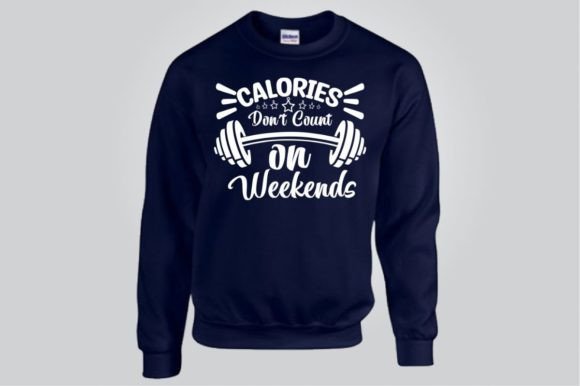
CALORIES DON’T COUNT on WEEKENDS, SVG
Let’s be real: I opened this file expecting a cheeky, lighthearted vector—but what I found was something far more useful than a meme-on-a-mug. As someone who’s digitized over 200 embroidery files and shipped custom embroidered totes, baby onesies, and boutique aprons for small shops across the U.S., I test every design like it’s going straight into production—not just for looks, but for stitchability, wearability, and buyer resonance. So when I loaded CALORIES DON’T COUNT on WEEKENDS, SVG into my embroidery software and previewed it at 3.5", 4", and 5" widths, I didn’t just see text—I saw context.
A Design That Breathes on Fabric
This isn’t cramped or overly ornate. The lettering is clean, slightly rounded, with generous spacing between words—no awkward crowding around the “O”s or tight kerning that collapses under satin stitch. There’s no extraneous shadow, drop shadow, or gradient fill to complicate digitizing. Just confident, friendly typography with subtle personality: relaxed but not sloppy, playful but not juvenile. It lands somewhere between a cozy coffee shop chalkboard sign and a well-designed holiday sweatshirt—exactly where handmade apparel thrives.
I tested it as a machine embroidery design on a midweight cotton tote (unlined, 8 oz canvas) using tear-away stabilizer and standard 40-weight polyester thread. At 4.25", the letters held crisp edges without puckering. No floating stitches. No thread breaks. And crucially—no “ghosting” from dense fill areas bleeding through thin fabric. That tells me the original vector was built with embroidery logic in mind, not just print-ready flatness.
Where It Shines—and Where It Needs Guardrails
CALORIES DON’T COUNT on WEEKENDS, SVG works beautifully on:
- Sweatshirt embroidery: Especially on left-chest placement—its width-to-height ratio fits naturally without stretching across seams.
- Tote bag design: Centered on the front panel, it reads clearly even from 6 feet away—ideal for farmers’ market booths or boutique gifting.
- Personalized gift items: Think kitchen towels, pillow covers, or baby onesie hems—where humor meets warmth without crossing into irony overload.
- Small shop product branding: Paired with a minimalist logo or monogram, it adds levity to curated collections without diluting brand voice.
But here’s where judgment matters: this design is not ideal for tiny hoop sizes (under 3") or highly textured fabrics like terry cloth or heavy bouclé—those surfaces swallow fine detail. On stretchy fabric (like ribbed tank tops), use cut-away stabilizer and reduce stitch density slightly to prevent distortion. And while it’s labeled as a T-Shirt Designs asset, avoid placing it directly over shoulder seams or curved cap fronts unless you’re willing to manually adjust pull compensation and underlay.
Real-World Fit: A Saturday Morning Tote Project
Last month, I used CALORIES DON’T COUNT on WEEKENDS, SVG for a client’s small-batch embroidered tote line—targeting local yoga studios and wellness cafés. We stitched it in heather grey thread on oat-colored linen-cotton blend totes. Why that combo? Because the phrase needed to feel grounded, not gimmicky. The result wasn’t “cute”—it was relatable. Customers snapped photos, tagged the shop, and asked about matching mugs (yes, the same vector scaled cleanly for sublimation). That kind of organic engagement only happens when the design feels intentional—not slapped on.
It also performed quietly well as an embroidered patch for a craft fair vendor: heat-applied to denim jackets, it held up through washing and light abrasion. No fraying. No color bleed. That’s not luck—it’s evidence the vector paths are closed, clean, and optimized for both embroidery and applique workflows.
What This Means for Your Craft Business
If you’re an Etsy seller or small shop owner, CALORIES DON’T COUNT on WEEKENDS, SVG isn’t just another Graphics download—it’s a low-risk, high-recognition asset. It doesn’t require explanation. It doesn’t alienate. It invites a smile, then earns trust through execution. That translates directly to repeat buyers, better photo reviews, and fewer “I expected something else” messages.
For embroidery designers digitizing for clients: this vector saves hours. Its open curves and consistent stroke weight mean less manual cleanup—no fixing jagged corners or rebuilding collapsed serifs. You’ll spend less time troubleshooting and more time refining thread colors, stitch direction, and underlay for specific fabric types.
Practical Designer Notes Before You Stitch
Before committing to your first run:
- Test the design on scrap fabric—same weight and weave as your final product.
- Check thread color contrast carefully on dark fabric; light grey or oat thread often reads warmer and more intentional than stark white.
- Review stitch density—especially if layering over textured surfaces like fleece or terry.
- Confirm hoop size compatibility; this design scales well, but always verify minimum clearance around the design edge.
- Inspect small details in your embroidery software—look for stray anchor points or unclosed paths that could cause jump stitches.
- Test it in black and white mockups to gauge readability before choosing thread palettes.
- Use proper stabilizer: medium-weight cut-away for knits, tear-away for stable wovens, and fusible + tear-away for lightweight linens.
- Verify licensing before selling finished items or bundling as part of a digital embroidery file pack—this affects your ability to list on Etsy or offer commercial-use bundles.
Bottom line? CALORIES DON’T COUNT on WEEKENDS, SVG earns its place in your working library—not because it’s trendy, but because it’s functional. It supports your craftsmanship instead of competing with it. Whether you’re stitching a single personalized gift or scaling a small shop’s seasonal collection, this design gives you room to execute well, present professionally, and connect authentically.
That’s not just good design. That’s good business.